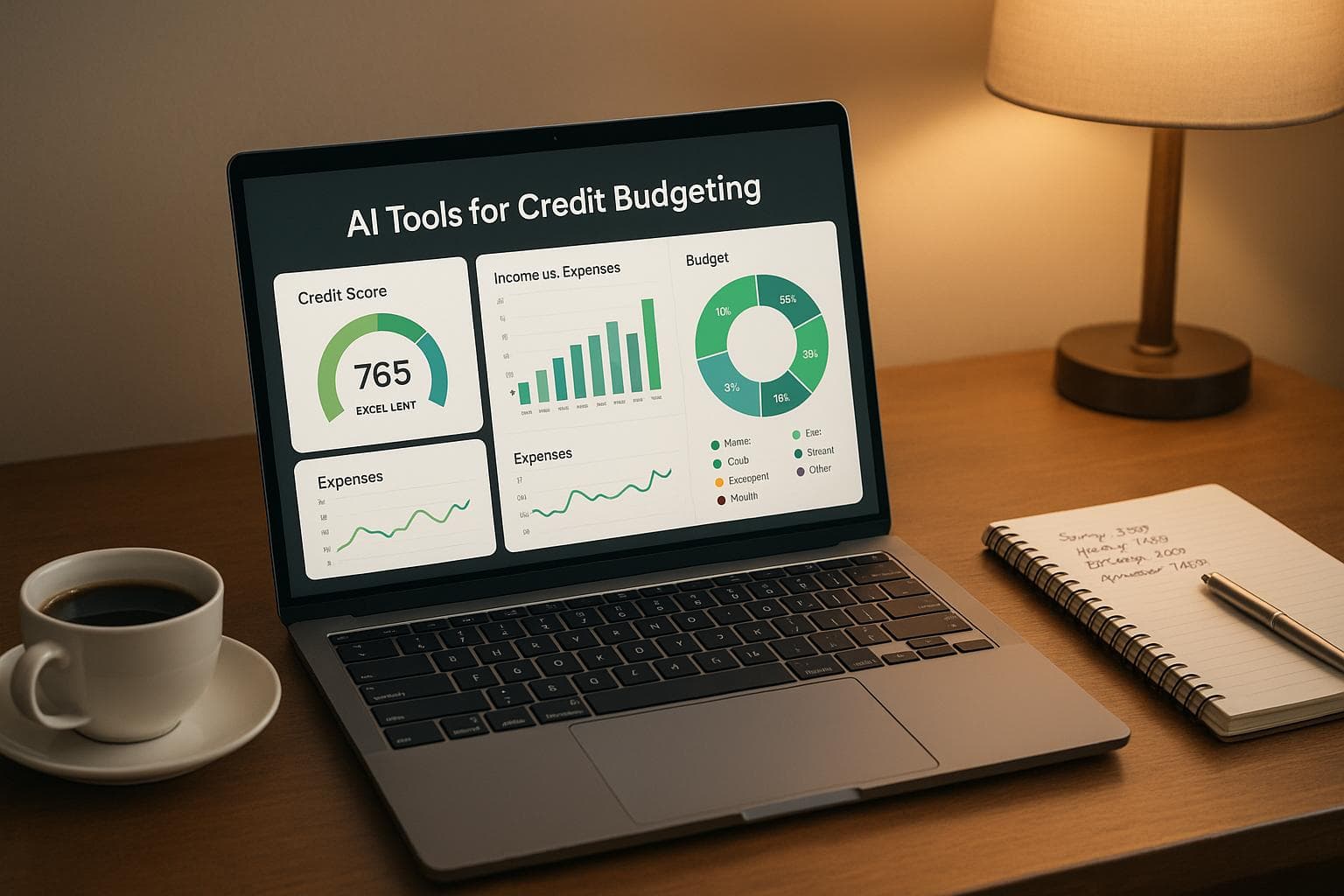
Managing your finances doesn’t have to be overwhelming. AI tools are reshaping how people handle budgets and improve credit scores. With 64% of Americans feeling stressed about money and only 40% actively budgeting, AI offers automated solutions that save time, reduce errors, and provide personalized financial strategies. These tools can cut expenses by 20%, increase savings by 30%, and help users achieve better credit scores faster.
Here’s how AI tools like CreditCaptain compare to manual budgeting methods:
- Customization: AI tools adjust budgets automatically based on your spending habits, while manual templates require time-consuming updates.
- Automation: AI handles repetitive tasks like tracking bills and credit utilization, unlike spreadsheets that demand manual input.
- Insights: AI predicts spending trends and suggests credit-improving actions, which static templates can’t do.
- Effectiveness: Users of AI tools report faster credit score improvements, with some seeing jumps of 90 points in six months.
Although manual methods are cheaper (or free), they require more effort and financial knowledge. AI tools, while pricier ($149–$299/month for plans like CreditCaptain), offer convenience and faster results. If you’re looking for a smarter way to manage your credit, AI tools might be worth exploring.
ChatGPT is Helping You Budget Off $7,000 in Credit Card Debt!
1. Traditional Budget Templates
Traditional budget templates, like Excel spreadsheets and the 50/30/20 rule, are designed to organize income, expenses, and savings. While they’re helpful for general financial management, they often fall short when it comes to tackling the specific challenges of credit improvement. Let’s break down why these traditional methods have limitations in this area.
Customization
Traditional templates allow for some level of customization - you can tweak categories, adjust amounts, and tailor them to your income and expenses. For example, you might create specific sections for rent, groceries, or debt payments. However, this flexibility has limits. Users need to have a solid understanding of their finances to make the right adjustments, and the process can be labor-intensive.
Unlike modern tools, these templates lack built-in intelligence. They won’t calculate the best strategies for paying down debt, optimizing credit utilization, or timing payments to boost your credit score. Instead, you’re left to figure these things out on your own. This can take a lot of time and requires a level of financial expertise that not everyone has.
Automation
One of the biggest drawbacks of traditional budgeting methods is the lack of automation. Every transaction has to be manually entered, categorized, and totaled. This is not only time-consuming but also prone to human error.
When it comes to credit-related tasks, the manual workload increases. You’d need to track payment due dates, monitor credit utilization across multiple accounts, and calculate debt-to-income ratios - all without any automated assistance. These methods don’t guide you toward the best actions for improving your credit, leaving you to navigate the process alone.
Actionable Insights
Traditional templates are great for showing where your money goes each month, but they don’t offer much beyond that. They’re not equipped to spot spending trends or suggest how to reallocate funds to improve your credit score. For instance, a template might show you how much you spend on dining out but won’t tell you how cutting back in that area could help lower your credit utilization.
These templates rely heavily on historical data, offering little in the way of forward-looking recommendations. Users are left to analyze the numbers themselves and figure out how to align their spending with credit improvement goals. This can be especially challenging for people who don’t fully understand how credit scores work.
"At the very basic level, there are a lot of consumers who still don't really understand how the credit scoring model operates and the various factors that improve or decrease a credit score." - Lance Triggs, President of the Program Operations Division, Operation Hope
Effectiveness in Credit Improvement
When it comes to improving credit, traditional templates are a mixed bag. They’re good at helping users stay on top of bills and avoid overspending, which are important for maintaining a healthy payment history. However, they lack the advanced features needed for more significant credit score improvements.
For example, these templates won’t help you optimize your credit utilization ratio, decide when to transfer balances, or determine the best strategy for paying down debt. Because they’re static tools, they don’t adapt to changes in your financial situation, like new accounts or fluctuating balances. This means you’ll need to regularly update and reassess your approach manually - a process that can be both tedious and inefficient.
That said, traditional templates do offer a level of transparency and control. They allow you to see exactly where every dollar is going, which can be empowering for those who are willing to put in the time and effort. But for anyone looking for smarter, more dynamic tools that can adapt to their financial changes, traditional methods may feel outdated.
2. AI-Powered Tools (e.g., CreditCaptain)
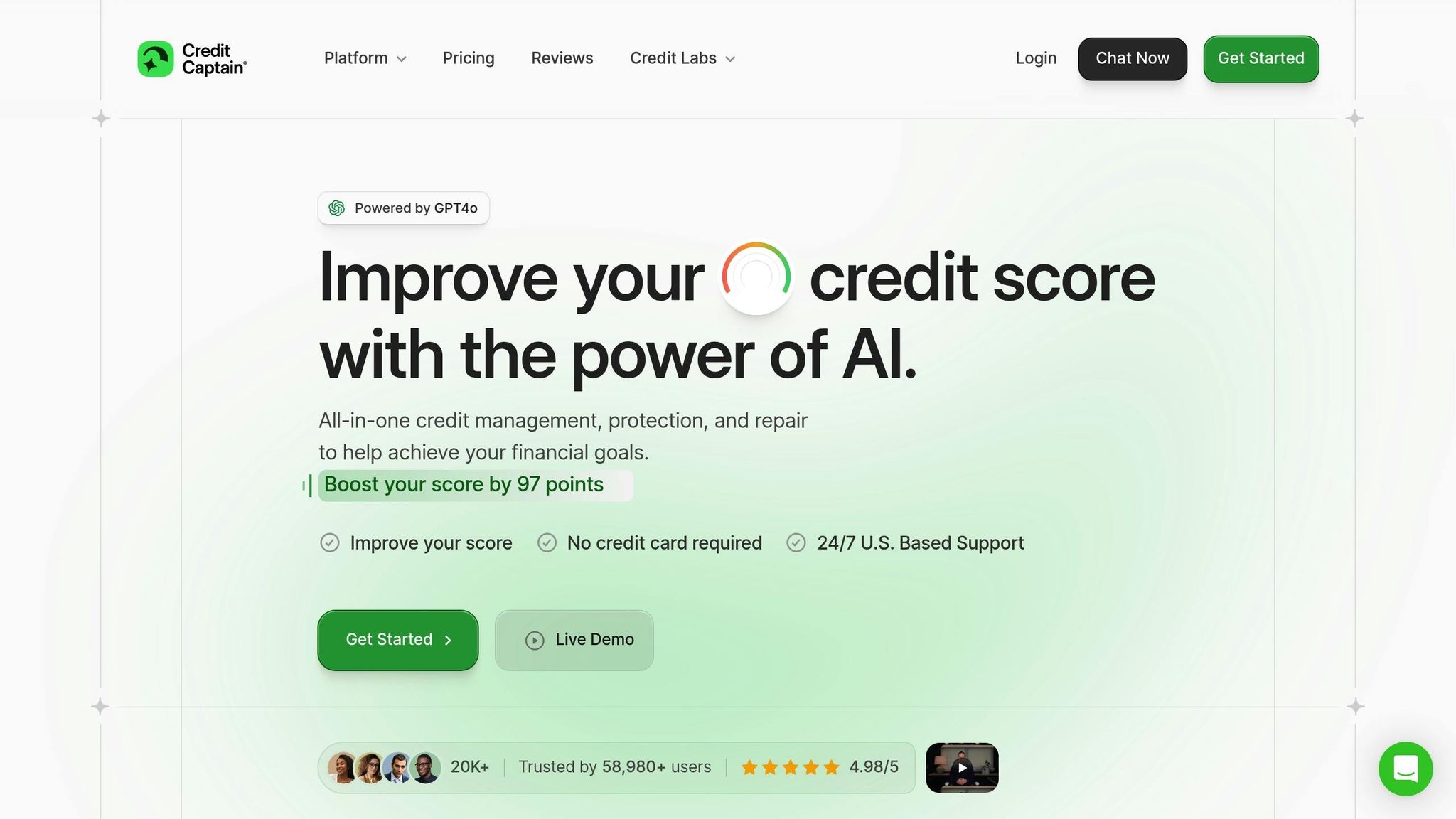
AI-powered credit budgeting tools are a game-changer compared to traditional methods. They combine intelligent automation with personalized recommendations tailored to your financial situation. By leveraging machine learning, these platforms analyze your spending habits, credit profile, and financial goals to create dynamic budgets that help improve your credit.
Customization
Unlike the manual adjustments required with traditional tools, platforms like CreditCaptain use real-time data to refine strategies automatically. The system continuously evaluates your financial behavior, delivering budgets and recommendations that evolve as your circumstances shift.
This isn’t just about tweaking a few spreadsheet categories. AI tools can pinpoint specific debt repayment strategies, optimize credit usage across accounts, and suggest the best timing for financial decisions. They also identify risks early - like concerning spending trends or potential payment conflicts - and adjust your budget accordingly. This proactive approach ensures your finances stay on track, even when unexpected challenges arise.
Automation
One of the standout features of AI-powered tools is their ability to automate tedious financial tasks. These platforms handle everything from categorizing transactions and tracking bill due dates to monitoring credit utilization. Some even take direct actions, like paying bills or disputing errors on your credit report.
For example, CreditCaptain simplifies credit management by automating disputes, real-time score monitoring, and goal-driven strategies. Users can spend less time on spreadsheets and more time focusing on actionable steps. The platform also provides real-time alerts for credit score changes, upcoming payment deadlines, or other critical updates, helping users avoid missed payments and costly mistakes. This seamless automation transforms raw financial data into clear, strategic actions.
Actionable Insights
AI tools don’t just track your spending - they analyze it to provide meaningful insights. These platforms identify spending patterns, predict future expenses, and suggest targeted steps to improve your credit. A survey by Credit Karma found that 71% of users saw their financial situations improve after using AI-driven budgeting apps.
These insights go beyond basic advice. AI tools can forecast how financial decisions - like balance transfers, new credit applications, or large purchases - might impact your credit score. This predictive ability helps you make smarter choices that align with your long-term goals, something static templates simply can’t offer.
Effectiveness in Credit Improvement
By combining tailored strategies with automated actions, AI-powered tools deliver measurable credit improvements. Their effectiveness often surpasses traditional methods. According to NerdWallet, users of these apps save an average of $1,000 annually, while a Harvard Business School study highlights their success in helping users achieve financial goals more consistently.
CreditCaptain exemplifies this effectiveness. The platform guarantees credit score growth through advanced AI automation. Many users report significant improvements - some have seen their scores jump from 580 to 670 in just six months by following the platform’s recommendations.
CreditCaptain offers flexible plans to suit different needs, ranging from Basic ($149/month) to Turbo ($299/month). These plans include unlimited AI-driven credit disputes, live score tracking, and adaptive growth strategies.
What sets these tools apart is their ability to adapt in real time. Whether you’re dealing with a job loss or unexpected expenses, the AI recalibrates your budget, suggests new strategies, and flags potential risks. This kind of dynamic support ensures you’re always equipped to handle financial challenges, something traditional templates simply can’t match.
sbb-itb-b2789ac
Pros and Cons
Choosing between traditional budget templates and AI-powered tools can feel like comparing apples to oranges. Each method has its strengths and weaknesses, and understanding these differences is key to deciding which one suits your credit improvement goals.
| Factor | Traditional Budget Templates | AI-Powered Tools (e.g., CreditCaptain) |
|---|---|---|
| Customization | Offers flexibility, but requires manual effort and a solid grasp of formulas and tracking methods to make adjustments | Automatically adapts to your financial behavior, providing tailored recommendations through data analysis |
| Automation | Limited automation - manual data entry, categorization, and updates are necessary | Handles disputes, score monitoring, transaction sorting, and bill tracking automatically, with real-time alerts |
| Actionable Insights | Basic calculations and static analysis; struggles to identify spending patterns or predict outcomes | Uses advanced algorithms to recognize patterns, predict trends, and give personalized advice |
| Credit Improvement Effectiveness | Depends on your knowledge and discipline to implement strategies effectively | AI-driven strategies promise faster credit score growth through automated actions |
| Cost | Often free or low-cost (e.g., $10–15/month for premium templates) | Higher monthly fees ($149–$299) but includes comprehensive credit management features |
| Learning Curve | Requires understanding budgeting principles and spreadsheet functions, which can be time-consuming | User-friendly and easy to set up, with AI managing the complex calculations for you |
Let’s unpack these differences with some real-world examples and expert opinions.
Traditional templates are great for those who value control and transparency. However, only about 40% of adults in the U.S. actively use a budget to track their spending. The challenge with traditional methods lies in their static nature. As Molly Nelson, a Certified Financial Planner, points out:
"If someone were to just hand their budget over to AI without knowing the person, it might just slash certain expenses that really for the person are non-negotiable".
This highlights that while manual methods offer control, they often lack the ability to adapt to changing circumstances.
AI-powered tools, on the other hand, excel in automation and analysis. Anthony DiMaggio, Co-founder of Candlestick AI, explains:
"AI can be used to automate that process and sift through that information for you. So it's reducing your effort while effectively managing your finances.".
In fact, 75% of consumers consider AI-powered tools essential for managing their finances. These tools are particularly strong in areas like fraud detection and spending pattern analysis. For example, AI systems can process millions of transactions in seconds, helping banks detect fraud in real time. This same technology can identify overlooked credit optimization opportunities.
That said, AI isn't perfect. Molly Nelson notes that AI struggles with qualitative factors that require human judgment. Another potential drawback is cost. While traditional templates are inexpensive and require more time investment, AI tools like CreditCaptain come with higher monthly fees. However, the trade-off is significant automation. According to an Experian report from October 2024, 96% of users who tried AI-driven finance apps reported positive experiences.
When it comes to credit improvement, the gap between the two approaches is clear. AI tools offer a more tailored experience, analyzing vast amounts of data quickly. Traditional methods, by contrast, often require more time and effort to achieve similar results. Still, some experts warn that heavy reliance on automation could reduce financial literacy by distancing people from their day-to-day financial decisions.
Andrew Lo, a Finance Professor at MIT Sloan School of Management, offers a balanced view:
"On the bright side, I think that a large number of individuals, who are currently not getting any financial advice and badly need it - they will have access to pretty good financial advice at no cost".
Ultimately, the choice boils down to what you value more: hands-on control or the efficiency of automated, data-driven results. Both approaches have their place, depending on your priorities and financial situation.
Conclusion
AI-driven tools have transformed the way credit improvement is approached, stepping far beyond the limitations of traditional budgeting methods. The numbers tell the story: the AI fintech market grew from $9.15 billion in 2022 to $11.59 billion in 2023, marking a 26.8% growth rate. AI-powered credit scoring systems also deliver significantly higher accuracy compared to conventional methods. These shifts highlight a growing trust in AI, with 75% of consumers believing it enhances financial decision-making and 60% already using AI tools to manage their finances.
For U.S. consumers aiming to improve their credit scores, AI tools offer a compelling mix of personalization, automation, and efficiency. These platforms go beyond basic budgeting by analyzing spending patterns, identifying opportunities to save, predicting future expenses, and recommending tailored financial strategies.
"AI is no longer a futuristic concept; it is actively reshaping the way individuals manage their money." - AIJ Guest Post
If you're serious about boosting your credit score, AI-powered solutions are worth considering. Unlike traditional budgeting, which requires extensive manual effort, AI tools take care of the heavy lifting by automating credit optimization tasks. For example, CreditCaptain leverages AI to handle dispute automation, real-time credit monitoring, and adaptive growth strategies - all designed to support effective credit improvement.
With 60% of Americans struggling to manage their finances effectively, and AI tools offering unmatched accuracy and tailored insights, adopting intelligent automation could be the key to achieving lasting credit health and financial stability.
FAQs
How does CreditCaptain use AI to simplify credit budgeting and improve credit scores?
CreditCaptain leverages AI and machine learning to take the guesswork out of credit management. It analyzes your credit report, spots negative entries like late payments or charge-offs, and creates tailored dispute actions automatically. This automation not only saves you valuable time but also simplifies a process that can often feel overwhelming.
On top of that, the platform provides real-time credit score tracking, personalized tips, and in-depth insights, all accessible through a user-friendly dashboard. By handling these tasks seamlessly, CreditCaptain makes improving your credit score easier and more efficient than relying on traditional methods.
What are the potential downsides of using AI tools for credit improvement, and how do they affect financial literacy compared to traditional methods?
While AI tools designed to improve credit scores bring speed and convenience, they aren’t without their challenges. These tools operate using complex algorithms, which can sometimes lead to errors or even biases in decision-making. Another concern is that relying too heavily on these tools might discourage users from engaging with essential financial principles, potentially weakening their overall financial literacy.
On the other hand, traditional methods, though less automated, often promote a hands-on approach to budgeting and credit management. Actively managing these tasks can help individuals build stronger financial skills over time - something that AI tools may not always encourage. Striking a balance between leveraging AI and maintaining a focus on learning the basics of personal finance can help address these potential drawbacks.
How do AI tools help improve credit scores, and what results can users expect?
AI tools can play a big role in boosting your credit score by diving into your financial data and pinpointing areas that need attention. Whether it's cutting down debt, improving how you use your credit, or fixing mistakes on your credit report, these tools are designed to help. Using advanced algorithms, they offer tailored recommendations and can even handle tasks like tracking your payments or suggesting smart credit management strategies.
With these AI-powered platforms, people often see quicker improvements in their credit scores, make smarter financial choices, and handle credit more efficiently. While individual results will differ, many users notice real progress within a few months, making these tools a helpful ally in reaching long-term credit goals.